
News and Events

Find out more about events hosted by the Edinburgh Centre for Buddhist Studies, as well as news about our activities.

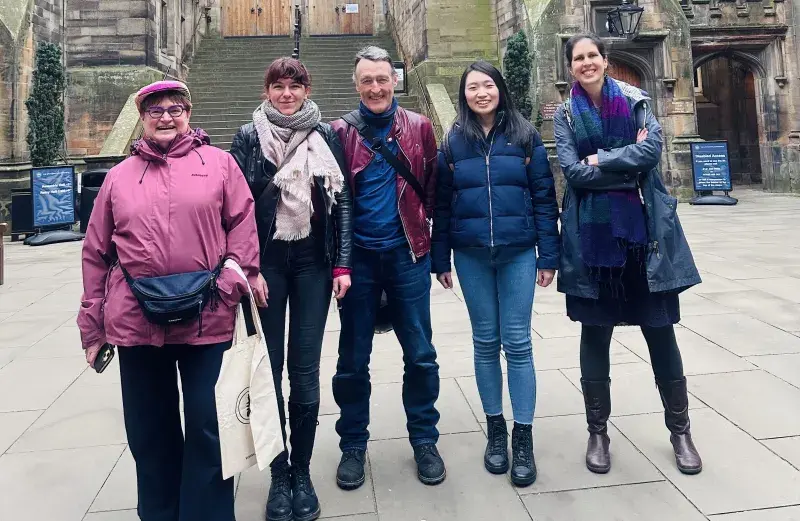
Five happy people standing in front of historic buildings
A gathering of ECBS colleagues during the visit of Prof Ann Heirman in spring 2025.

Events for the 2025-2026 academic year

We have some exciting events planned for the coming academic year, when we will also be welcoming our first cohort of masters students to ECBS. 


Monday 15th September 2025, 12.30-1.30pm, Rainy Hall, New College

ECBS lunch

Join us for the first ECBS lunch of the semester, when we welcome our new cohort of students and reconnect with existing members. Bring your own lunch or buy from the Rainy Hall cafe. We will meet weekly during semester at the same time and place, for informal conversation.


Tuesday 23rd September 2025, 4.10-5.30pm, Martin Hall, New College

Dr Halle O'Neal: Tracing Emotions in Calligraphy, Paper, and Buddhist Rituals of Medieval Japan (Religious Studies research seminar)

Abstract:

With the cataclysm of death, what happens to those remaining fragments of a life, which appear disposable to others but become the mourner’s heart-breaking distillations of both loss and trace? While a fading practice today, handwritten letters in medieval Japan were the primary form of communication between long-separated lovers, parents unlikely to reunite with their children, and distant friends, artists, and poets. In this rich epistolary culture, letters – reused, recycled, and reframed – figured prominently in Buddhist memorial rituals. With the death of a loved one, family members gathered the dead’s letters and transcribed sacred scripture on their surface, transforming the original missive into a letter sutra (shōsokukyō). Adorning these scrolls with gold, silver, and indigo dyes, women were the first to make memorial palimpsests. Indeed, they invented a wider cultural practice in which mourners tempered grief by transforming the everyday traces of loved ones into potent objects. This talk explores the creative methods deployed by women in coping with death and loss, the ephemerality and afterlives of letters, paper’s fragmentation via reuse and recycling, and the haptic engagement with layered manuscripts.


Friday 26th September 2025, 5:15pm, Meadows Lecture Theatre, Old Medical School, Doorway 4

Philippe Buc (Leiden University): “Buddhadharma, rajahdarma, regnum, sacerdotium: Some Comparisons between Medieval Japan and Western Medieval Europe” 

Hosted by CMRS

Friday 3rd October 2025, 10am-12pm, University of Edinburgh Main Library, room 1.07

Book donation and reception

This event is by invitation only. It will include talks and a tea ceremony, led by representatives from the Manchester Fo Guang Shan Temple, and marks the receipt by the library of a donated copy of The Encyclopedia of Buddhist Arts.


Friday 10 October 2025, 11am-12pm, Elizabeth Templeton Lecture Theatre, New College

Justin McDaniel (University of Pennsylvania): Living Deliberately through Existential Despair

Justin McDaniel’s research is within Buddhist Studies and a broader study of human flourishing. In this talk, he explores two courses he teaches that ask students either to take on monastic vows (no tech for a month, no speaking or touching, food & dress restrictions, etc.) or read books cover to cover from 5pm to midnight in silence. It will discuss student experiences, and why turning off and learning how to single-task can lead to unexpected felicities and revelations. This is a joint event for the Edinburgh Centre for Buddhist Studies and the Scottish Network for Religion and Literature.


Tuesday 4th November 2025, 4.10-5.30pm, Martin Hall, New College

Dr Sara Swenson (Dartmouth): "Sharing Hearts: Buddhist Humanitarianism and Mutual Aid in Vietnam" (Religious Studies research seminar)

Abstract:

Recent scholarship on Buddhist humanitarianism tends to focus on large-scale movements. For example, several studies document how major organizations like the Tzu Chi Foundation have expanded rapidly to address social-service needs, offer disaster relief, and mobilize volunteers across Asia. However, in contemporary Vietnam, informal mutual-aid efforts have grown alongside formal humanitarian programs. These small-scale movements are difficult to trace and document. Some groups lack official registration with the government. Other groups derive from indigenous sects of Buddhism that lack international recognition. Still others operate through almost untraceable semi-private spaces of personal bank accounts and closed chats on messaging apps, which can make mutual-aid efforts difficult to distinguish from personal generosity. Yet, these informal movements have major effects on both donors and recipients. Real material needs are met among recipients. Existential needs are also addressed as online forums and in-person events reshape philosophical interpretations of Buddhism. Grassroots charity events function as sites where unconventional community leaders adapt concepts like “dana” and “merit-making” to new economic and political circumstances. This paper draws on ethnographic research following Buddhist aid organizations in Ho Chi Minh City, Vietnam. The three case studies presented show how charities are more than a failsafe for decentralized social services—rather, they are a vital resource for community members to find connection and meaning in a rapidly changing world.


Wednesday 5th November 2025, 4.15-6pm, 50 George Square, Room 1.06 (Project Room)

Florence Galmiche (Université Paris Cité): "Human and Animal Destinies Intertwined: Buddhist Rituals for Animal Rebirth in Contemporary South Korea"

Florence Galmiche is an anthropologist, an associate professor at Université Paris Cité, and a member of the ‘China, Korea, Japan’ laboratory and the Institut universitaire de France. Her research focuses on religion and ritual in Korea, with a particular interest in the relations between lay and monastic Buddhism, religious practices that seek to intervene in the world and effect change, and the relationship between the living and the dead. She also investigates the treatment of the remains of Korean forced labourers in Japan, and the ways civic and religious groups engage with memory and ritual care.

Part of the Asian Studies seminar series. This talk is supported by the Academy of Korean Studies.


Friday 7th November 2025, 5.30-6.30pm, Martin Hall, New College with Prof Sasson joining online

Vanessa R. Sasson: "The Gathering: A Story of the First Buddhist Women" (New College Festival of Books and Belief)

What do we see differently when we become the creator, rather than the consumer, of stories? This is what Vanessa Sasson, an academic in the field of Buddhist Studies, set out to do in her first novel, ‘Yasodhara and the Buddha’ (Bloomsbury 2021), telling the Buddha’s life story through the eyes and experiences of his abandoned wife.

Her second novel, ‘The Gathering’ (Equinox 2023), goes further still, exploring the story of the first Buddhist women’s request for ordination. Sasson will be joining Naomi Appleton in conversation as they explore not only the ways in which Sasson’s research feeds into her creative writing, but also how creative writing might be viewed, in itself, as a form of academic practice. 

Please note: while this is an in-person event, Vanessa R. Sasson will be joining on the big screen from Canada.

Further information and booking on the Festival website.


Monday 1st December 2025, 2-5pm, Senate Room, New College (and hybrid via Zoom)

Panel Discussion: Humour in Premodern Buddhist Literature

Join us for this workshop featuring presentations and discussion around the following questions:

What is humour? 

What makes something funny? What are the different types or modes of humour, such as parody and satire, that we find in premodern Buddhist texts?

Is humour cross-cultural?

To what extent is humour culturally specific? What types of humour are able to travel across linguistic and cultural boundaries? Why do we still laugh at certain things even in texts far distant from ourselves?

What is humour for (in Buddhist literature)?

Is there such a thing as distinctively Buddhist humour? How does humour relate to moral teaching or monastic discipline? When does humour become transgressive or ethically difficult? Can humour be used to explore or communicate Buddhist ideals?

Schedule:

From 2pm arrival and coffee

2.10-2.30pm Naomi Appleton: Humour in early Indian narrative

2.30-2.50pm Upali Sraman: Humour in the Vinaya

2.50-3.00pm coffee break

3.00-3.20pm Jan Nicol: Humour in the Liudu ji jing

3.20-3.40pm Rajyashree Pandey: Humour in premodern Japan

3.40-3.50pm coffee break

3.50-5.00pm roundtable discussion 

Register via EventBrite


SEMESTER 2


Wednesday 14th January 2026, 12.30pm, Rainy Hall, New College, then from 1-4pm in McIntyre Room

ECBS lunch and writing retreat

Join us for the first ECBS lunch of the semester. Bring your own lunch or buy from the Rainy Hall cafe. We will meet weekly during semester at the same time and place, for informal conversation. (This will not include Flexible Learning Week 18th February. The last will be 1st April.) This semester we are also trialling a writing retreat in the McIntyre Room, New College. 


Tuesday 20th January 2026, 11-12.30pm (with coffee from 10.30am), Senate Room, New College (and hybrid via Zoom)

Biography Across the Ancient World: A Panel Discussion

Telling stories of the lives of important people feels like a universal human activity, but biography as a genre begins to flourish only in the one or two centuries either side of the start of the Common Era, when it suddenly becomes the focus for composers as far apart as the ancient Mediterranean and early China. Whether it’s the first biography of Jesus or Buddha, the interrelated accounts of Chinese historical figures or the story of Mani’s life and travels, what motivates communities to focus on the life of key people and develop their stories? What is the relationship between biography and history, or between biography and devotional practice or doctrinal development? How does autobiography relate to this flourishing of literary and narrative practice, and does visual culture develop new types of human portrayals at the same time?

Join us for what promises to be a fascinating panel discussion, with short papers from four experts and then a wider discussion. 

Featuring:

Special guest Prof Charles Hallisey (Harvard) on early Buddhist biography

Prof Helen Bond (Divinity) on early Christian biography

Prof Joachim Gentz (Asian Studies) on early Chinese biography

Dr Philippa Townsend (Divinity) on the biography of Mani

Attendance is free and open to all, but requires registration. To attend please sign up through the Eventbrite page and select either in-person or online attendance. Note there are limited spaces to attend in person so please only register if you are certain you can attend.


Tuesday 20th January 2026, 4.10-5.30pm, Martin Hall, New College (and hybrid via Zoom)

Charles Hallisey (Harvard Divinity School): “Seeing Things with Words: Relishing Beauty with Buddhist Literature and Why It Matters”

The Khyentse Lecture in Buddhist Studies 2026.

Abstract:

The production and appreciation of literature have long been part of the religious lives of Buddhist communities across Asia.  Indeed, Buddhists were centrally visible in the earliest literary cultures in ancient India.  This givenness of literature in Buddhist life encourages us to ask just what it is about literature that Buddhists have valued and to consider what we can learn from this about the Buddhist traditions as well as what we can learn from Buddhist examples about how we might ourselves relish the beauty that is before us and around us.

To attend online you need to register via EventBrite. In person attendance does not require registration.


Monday 23rd February 2026, 4-5.30pm, Elizabeth Templeton Lecture Room, New College

Film screening: Chöd: The Journey into Cutting the Self

Join us for this screening of a documentary film about a Tibetan ritual practice, followed by a discussion with the film-maker Eduard Vasile. 


Monday 2nd March 2026, 11am-5pm, Senate Room, New College

Works-in-Progress workshop

Our annual sharing space for work in progress. Attendance in person only and limited to ECBS members.


Wednesday 4th March 2026, 4.10-5.30pm, Martin Hall, New College and online via Zoom

Book launch: Animals in Premodern Japan - The Encyclopaedia of Andō Shōeki 安藤昌益 (1703-1762) by Melissa Ann Kaul


Thursday 12th March, 5.15-6.30pm, online only

Carolyn Wargula: Materialising Rebirth: Funerary Hair Embroideries in Medieval Japan

How did needlework engage audiences differently by transforming recognisable painted Buddhist images into textured surfaces? This talk addresses this question by discussing the practice of hair and silk embroidery that emerged in twelfth-century Japan. By weaving together analyses of neglected textiles, this talk tells a new story of the affective, aesthetic and religious life of premodern Japan: one where fabrics gave material presence to mourning, needlework enacted Buddhist enlightenment, and vibrant threads resuscitated the presence of female saints like Chūjōhime.

Part of the History of Art Research Seminar Series. Please book via the EventBrite page. 


26th March, 5:30 PM JST | 8:30 AM GMT | 10:30 AM IDT on Zoom

Roundtable: "Embodiments in Japanese Buddhism: Gender, Power, and Statuary”

Welcome remarks by Halle O’Neal | Organized by Julia Cross

Recent scholarship in Buddhist studies and art history has increasingly turned to the body, and the gendered body in particular, as a site of critical analysis. This online panel brings together three papers examining embodiments in premodern Japanese Buddhism and art history, exploring how human and divine bodies function as sites of ritual authority, political imagination, and religious power.

The first paper, by Julia Cross, explores Kisshōten (Skt. Lakṣmī) as a physical and symbolic representation of idealized female rulership in ancient to medieval Japan. Through analysis of statuary, ritual, and doctrine, Cross argues that Fujiwara women, including Empresses Kōmyō and Kōen (8th c.), worshipped Kisshōten as a means of spreading Buddhism and proving their own legitimacy as female rulers. Extending into the medieval period, the continuance of repentance rituals (keka) dedicated to Kisshōten at Nara temples demonstrates Kisshōten’s continued political and ritual significance as a female embodiment of sovereignty.

The second paper, by Daniel Borengasser, examines Retired Emperor Goshirakawa’s (1127–1192) cultic devotion to Senju Kannon (Thousand-Armed Avalokiteśvara) and his ritual identification with the bodhisattva through the sculptural program of Sanjūsangendō in Kyoto. Focusing on Goshirakawa's recitation of dhāraṇī in this hall—which enshrines 1,001 statues of Senju Kannon—Borengasser analyzes how vocal practice, inscription, deposited votive objects, and sacred space facilitated a harmonization between royal and divine bodies. Through embodied recitation and ritual interpenetration, Goshirakawa aligned his singular body with the multiple bodies of Senju Kannon, an esoteric deity symbolic of cosmic sovereignty.

The third paper, presented by Chihiro Saka, examines Datsueba—the female deity known as the “clothes- stealing old woman”—who estimates the deeds of the dead on the banks of the Sanzu River. After her first appearance in the eleventh century, her persona developed into a multifaceted character through interactions with various figures sharing the same physical trait, namely the aged female body. This aged and gendered body also functioned as a mediating form that shaped the development of other female figures. By examining cases in which Datsueba sculptures were repurposed to represent other Buddhist and folkloric female figures in Japan, Saka demonstrates how Datsueba’s embodied image contributed to the transformation and expansion of multiple historical and religious identities.

The panel concludes with remarks by Or Porath. As discussant, Porath will draw thematic connections among the three papers, reflecting on how gendered, aging, divine, and royal bodies operate as sites of religious authority and political imagination. Situating these studies within broader scholarship on embodiment in Japanese religions and art history, he will consider how attention to corporeality reshapes our understanding of religious icons.

For the Zoom link email buddhist.studies@ed.ac.uk


Thursday 11th June 2026, 10am-2.30pm, National Museum of Scotland

Our annual "Discovery Day" for school pupils

Bring your National 5 and Highers/Advanced Highers pupils into Edinburgh for a day designed to broaden their learning about Buddhism. The day includes a Q&A session with a Thai Buddhist monk, guided meditation with a Zen Buddhist priest, taster lectures from Buddhist Studies scholars, and a Treasure Hunt for Buddhist objects at the National Museum of Scotland. There is no charge for this event.
 
For further information and to secure your place, contact halle.oneal@ed.ac.uk.

24th-26th June 2026, New College

Buddhism and Emotion conference

Follow the link to the separate conference webpage: 2026 UKABS conference on Buddhism and Emotion


Check back later for details of future events, or contact buddhist.studies@ed.ac.uk to be added to our mailing list or membership.

Past events

To see details and pictures from our past events click below.

News

In autumn 2025, people from outside the University will be able to join students in learning Classical Tibetan, in a new course taught by Dr Upali Sraman. The format involves a mix of live classes (hybrid enabled) and online self-paced learning, making it possible for both locals and those from further afield to give this fascinating language a go. 


We're delighted to announce that we have been granted the status of a University of Edinburgh Research Centre. As such, we will be changing our name to the Edinburgh Centre for Buddhist Studies (ECBS) and continuing to build upon our events programme and other activities.


Comprising of a fee-waiver by the University of Edinburgh and a stipend from the Khyentse Foundation, one lucky student will be awarded this scholarship for a full-time on-campus PhD starting September 2025.

See further details on the scholarship webpage.


EBS will launch a new taught Masters programme in Buddhist Studies in September 2025. Applications open in the autumn for this one-year (two-year part-time) on-campus programme. For details, including entry requirements and how to apply, see the Programme Webpage


August 2023

We are delighted to write with the good news that EBS has made an exciting hire for the Buddhist Languages & Cultures post.

This position has been made possible through generous funding from the Khyentse Foundation and Divinity at the University of Edinburgh. We had an outstanding pool of candidates, and we are pleased to welcome Upali Sraman to our team. Upali recently completed his PhD in Religion at Emory University and is an ordained Buddhist priest with an MDiv from Harvard. He brings a wealth of expertise to our program and will be teaching Sanskrit, Pali, and Tibetan, in addition to offering courses on his dissertation research on bodily practice within the Vinaya. We look forward to having him join us and make significant contributions to our community.


Thanks to a new grant from the Foundation starting in January 2022, we have been able to appoint a dedicated schools outreach officer for EBS, Dr Paul Fuller. Alongside his role teaching in the School of Divinity, Dr Fuller will work one day per week on schools outreach, including school visits, resource creation, and the organisation of our annual Discovery Day for pupils.